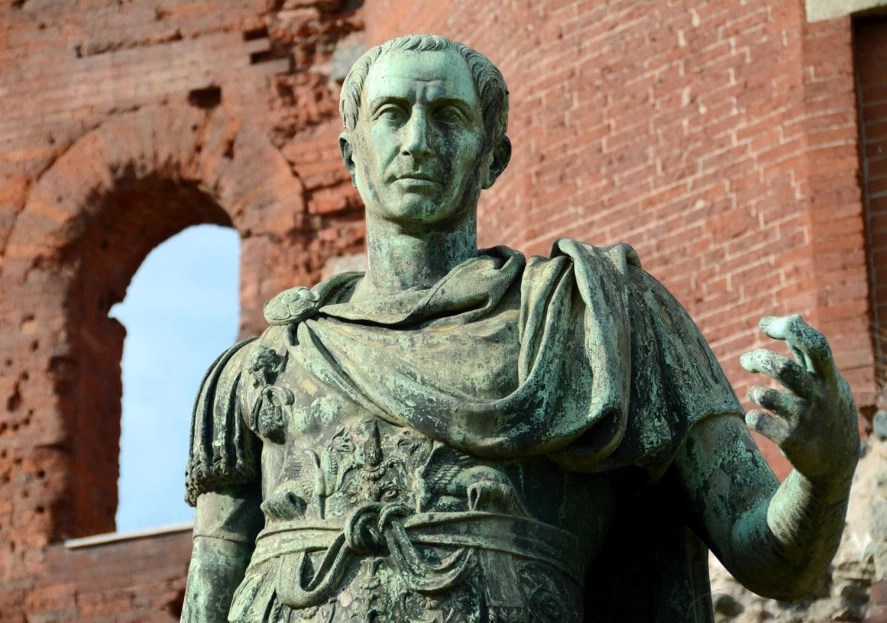
Plutarch’s telling of Caesar’s life portrays a man marked by relentless ambition, masterful strategic thinking, and a gratitude-filled disposition toward those that give their lives to him in service, whether in battle or everyday existence. From the start of his life, Caesar “was on the wrong side. Most people in that position would have stayed hidden or at lease tried to live quietly; but Julius Caesar was never most people.”[1]
Caesar’s Governing Virtues
Caesar embodied determination from a noticeably early age. His enemies “too late they found that there is not beginning so mean, which continued application will not make considerable; and that despising a danger at first will make it at last irresistible.”[2] It seems, from Plutarch’s perspective, Caesar’s drive made him unstoppable from the beginning. In a moment shared with his mother, he says“Mother, today you will see me either high priest or an exile.”[3] He chose to stand strong in his convictions and read the spirit of the times. He knew he could end up on the wrong side of history, as many leaders before and after him understood, but he believed his chosen path was worth the possible sacrifice that could accompany defeat and failure. Throughout Caesar’s Life, Plutarch focuses on Caesar’s unwavering decisiveness and conviction in the face of uncertainty. His leadership, remarked Plutarch, “showed him to be a soldier and general not in the least inferior to any of the greatest and most admired commanders who have ever appeared at the head of armies.”[4] He went as far as to say, “Caesar’s skill and his deeds of arms did excel them all together.”[5] We can see from Plutarch’s depiction, Cassar was the complete stateman: he “immediately won many men’s good wills,” pursued his goals with strategic ambition, and made governing decisions, “simply to please the common people.”[6],[7]
Caesar’s Health Issues
Plutarch chose to highlight Caesar’s health struggles throughout his Life. Caesar “always continued all labour and hardness, more than his body could bear” and “did not make the weakness of his constitution a pretext for his ease.”[8] Plutarch ties this directly to Caesar’s ability to inspire his men. “Now Caesar himself did breed this noble courage and life in them.”[9] Despite chronic illness, Caesar never allowed his difficulties to deter him from his goals. The examplar of such a powerful leader remaining strong inspite of chronic illness allows for vicarious experience for readers that have yet to face illness or challenges that may hinder progress. His illness could easily serve as an opportunity to shy away from public life, but Caesar chose to push ahead regardless of the challenges.
Private Life
Plutarch highlights Caesar’s private character as well as his public persona. Plutarch tells two stories that speak to Caesar’s generous side. When he and his men were invited to Valerius Leo’s home for a meal, the host served the vegetables with a sweet perfume sauce instead of the appropriate oil mixture. Caesar’s men began to speak ill of the host and make comments about his low breeding due to the mistake. Caesar immediately stopped his men and said, “not to eat what you did not like; but he who reflects on another man’s want of breeding shows he wants it as much himself.”[10] On another evening, Caesar and his men were caught in a storm, and they had to take shelter in the small home of a poor man. The accommodations did not allow for all the men to sleep inside the small space, so Caesar ordered the indoor space be given to one man in his party suffering from bad health, while he and the rest of the group slept outside under and awning.[11]
Relentless Ambition
Caesar led with relentless ambition, but he tempered it with hope, generosity, and strategy. Plutarch states, “for he never failed to dismiss all with present pledges of his kindness in hand, and further hopes for the future.”[12] Regardless of the outcome of a battle or political conquest, he chose hope. And when Pompey ordered Caesar to return the soldiers he sent, “Caesar returned them, and made each soldier a present of two hundred and fifty drachmas.”[13] Finally, while attempting to garner favor with influential decision-makers, he sent “large gifts” to encourage those men to support his efforts.[14]
Plutarch tells the stories of virtue and vice. He said, “Caesar was born to do great things, and had a passion after honour; and the many noble exploits he had done did not now serve as an inducement to him to sit still and real the fruit of his past labours, but were incentives and encouragements to go on, and raised in him ideas of still greater actions, and a desire of new glory…It was in fact a sort of emulous struggle with himself…how he might outdo his past actions by his future.”[15] It seems from this observation that Caesar’s ambition was a guiding force, the most powerful force, throughout his life. When passing by a “village of barbarians” he explained to his inquiring men that, “For my part, I had rather be the chiefest man here, than the second person in Rome.”[16] Second to anyone meant losing for Caesar. And in death, his generosity toward the people of Rome drove them to honor and avenge him, even after he was gone.[17]
For readers, Plutarch’s Caesar serves as an exemplar of determination, courage, and the potential of a single life directed by purpose. Though deeply flawed, Caesar represents a leader who refuses to settle for comfort or complacency. By relaying and interpreting his successes and shortcomings, Plutarch offers a portrait meant not to flatter power, but to awaken moral imagination. True greatness demands sacrifice, wisdom, and the humility to serve others even while reaching for the highest honors.
[1] Plutarch, The Plutarch Project, Volume Three: Julius Caesar, Agis and Cleomenes, and the Gracchi, rev. Anne E. White (2021), 7.
[2] Ibid., 11.
[3] Ibid., 14.
[4] Ibid., 21.
[5] Ibid.
[6] Ibid., 11.
[7] Ibid., 20.
[8] Ibid. 22.
[9] Ibid.
[10] Ibid., 7.
[11] Ibid.
[12] Ibid., 29.
[13] Ibid., 39.
[14] Ibid.
[15] Ibid., 71.
[16] Ibid., 15.
[17] Ibid., 79.
 Angelica Kajiwara
Leave a comment